 A refinery is a factory. A refinery takes a raw material (crude oil) and transforms it into petrol and hundreds of other useful products. A typical large refinery costs billions of pounds to build and millions more to run and upgrade. It runs around the clock 365 days a year, employs hundreds of people and occupies as much land as several hundred football pitches.
A REFINERY breaks crude oil down into its various components, which then are selectively changed into new products. This process takes place inside a maze of pipes and vessels. The refinery is operated from a highly automated control room.
All refineries perform three basic steps:
- Separation (fractional distillation)
- Conversion (cracking and rearranging the molecules)
- Treatment
Separation: fractional distillation
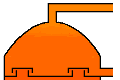
Modern separation involves piping crude oil through hot furnaces. The resulting liquids and vapours are passed into distillation towers:
|
| FRACTION | B Pt oC | Number of carbons | Uses |
|
|
|
|
|
|
|
|
|  | »Refinery gas |
| 1-4 | Bottled gas, fuels |
| »Petrol | 40 | ~8 | Fuel for cars |
|  | »Naptha | 110 | ~10 | Raw material for chemicals and plastics. |
|  | »Kerosine | 180 | ~15 | Fuel for Aeroplanes |
|  | »Diesel | 250 | ~20 | Fuel for cars and lorries |
|  | »Oils | 340 | ~35 | Fuel for Power Stations, Lubricants and grease |
| Hot crude » |  | »Bitumen | 400+ | 40+ | Road surfacing. |
- It is important to realise that the column is hot at the bottom and cool at the top.
- The crude oil separates into fractions according to weight and boiling point.
- The lightest fractions, including petrol and liquid petroleum gas (LPG), vapourise and rise to the top of the tower.
- Kerosine (aviation fuel) and diesel oil, stay in the middle of the tower
- Heavier liquids separate lower down.
- The heaviest fractions with the highest boiling points settle at the very bottom.
TRENDS AS WE UP AND DOWN THE COLUMN
The following table shows how the behaviour of the hydrocarbon molecules alter:
| AT THE TOP OF THE COLUMN |
| AT THE BOTTOM OF THE COLUMN |
|
|
|
| |
| |
| |
| |
| |
| |
- Gases & very runny liquids
|
| |
| |
| |
| |
| |
| |
| |
|
|
|
| Petrol comes off near the top of the column. Does the list above describe petrol? |
| Fuel oil comes off near the bottom of the column. Does the list above describe fuel oil? |
The fractions are now ready for piping to the next areas within the refinery. Some fractions require very little additional processing. However, most molecules require much more processing to become high-value products.
Conversion: cracking and rearranging molecules
 Some fractions from the distillation towers need to be transformed into new components . This is where a refinery makes money, because the low-value fractions that aren't in great demand can be converted to petrol and other useful chemicals.
The most widely used conversion method is called cracking because it uses heat and pressure to "crack" heavy hydrocarbon molecules into lighter ones. A cracking unit consists of one or more tall, thick-walled, reactors and a network of furnaces, heat exchangers and other vessels. Catalytic cracking, or "cat cracking," is the basic petrol-making process. Using intense heat (about 600°C), low pressure and a powdered catalyst (a substance that speeds up a chemical reaction), the cat cracker can convert most of the heavy fractions into smaller more useful molecules.
Some refineries also have cokers, which use heat and moderate pressure to turn the really heavy fractions into lighter products and a hard, coal like substance that is used as an industrial fuel.
Cracking and coking are not the only forms of conversion. Other refinery processes, instead of splitting molecules, rearrange them to add value. Alkylation makes petrol components by combining some of the gaseous byproducts of cracking. The process, which essentially is cracking in reverse, takes place in a series of large, horizontal vessels.
Reforming uses heat, moderate pressure and catalysts to turn naphtha into high-octane petrol.
Treatment: the finishing touch
Today, a major portion of refining involves blending, purifying, fine-tuning and improving products to meet specific requirements. To make petrol, refinery workers carefully blend together a variety of hydrocarbons. Technicians also add performance additives and dyes that distinguish the various grades of fuel. By the time the petrol is pumped into a car it contains more than 200 hydrocarbons and additives.
Example: Petrol companies produce different blends of fuels to suit the weather. In winter, they put in more volatile hydrocarbons (with short carbon chains) and in summer they add less volatile hydrocarbons to compensate for the higher temperatures.
Source:moorlandschool.co.uk
Read full story. . .
. . .Go back
 What is natural gas?


